NCN OPUS 30 Research Project
In the OPUS 30 call, concluded in June 2026, the National Science Centre (NCN) awarded me PLN 1.68 million to carry out a four-year research project entitled " Beyond Anderson’s theorem: Disorder Effects on Electrons, Phonons, and Superconductivity in Complex Alloys" (project no. 2025/59/B/ST3/01621).

The idea behind the project evolved from our previously completed NCN Sonata Bis project,
which demonstrated how complex the description of superconductivity in
multicomponent alloys can be and how many aspects of this problem remain
poorly understood.
In the present project, we will investigate the influence of disorder on
superconductivity in alloys ranging from binary systems to high-entropy
alloys (HEAs), following four main research directions:
- WP1 – Electrons: Calculations of the electronic
structure, Bloch spectral functions, scattering times, and transport
properties of representative binary alloys and high-entropy alloys using the
KKR-CPA method. The strength of disorder will be quantified and the
materials will be classified into weak-, intermediate-, and
strong-scattering regimes using criteria such as the relation between the
electronic scattering rate and the Debye frequency, as well as the
broadening of electronic bands relative to the superconducting energy-gap
scale.
- WP2 – Phonons: Calculations of lattice dynamics in
disordered alloys using SQS supercells, including local structural
relaxation. We will determine phonon spectra and disorder-induced phonon
broadening, separate the contributions originating from atomic-mass
fluctuations, force-constant variations, and local structural distortions,
and test descriptive parameters such as the mass-fluctuation parameter.
- WP3 – Electron–phonon interaction: First-principles
calculations of electron–phonon matrix elements and Eliashberg spectral
functions. The electron–phonon coupling constant and characteristic phonon
frequencies will be determined for representative binary alloys and HEAs,
going beyond the RMTA-based estimates used in our previous studies.
- WP4 – Superconductivity: Modelling of the superconducting state using superconducting density functional theory (SCDFT), as well as isotropic and anisotropic Eliashberg theory, extended to include disorder within the Born approximation and scattering-matrix formalism. Based on the results obtained in WP1–WP3, we will calculate the superconducting critical temperature (Tc), the specific-heat jump, and critical fields. We will also develop simplified expressions for Tc that explicitly account for the effects of disorder.
Project team: Andrzej Kądzielawa, Paweł Wójcik, Bartlomiej Wiendlocha, and three additional researchers currently being recruited. The project funding will support, among other things, the purchase of a multiprocessor computational server with a large amount of RAM, scientific software, scholarships for PhD and MSc students, conference participation, and computer equipment and materials.
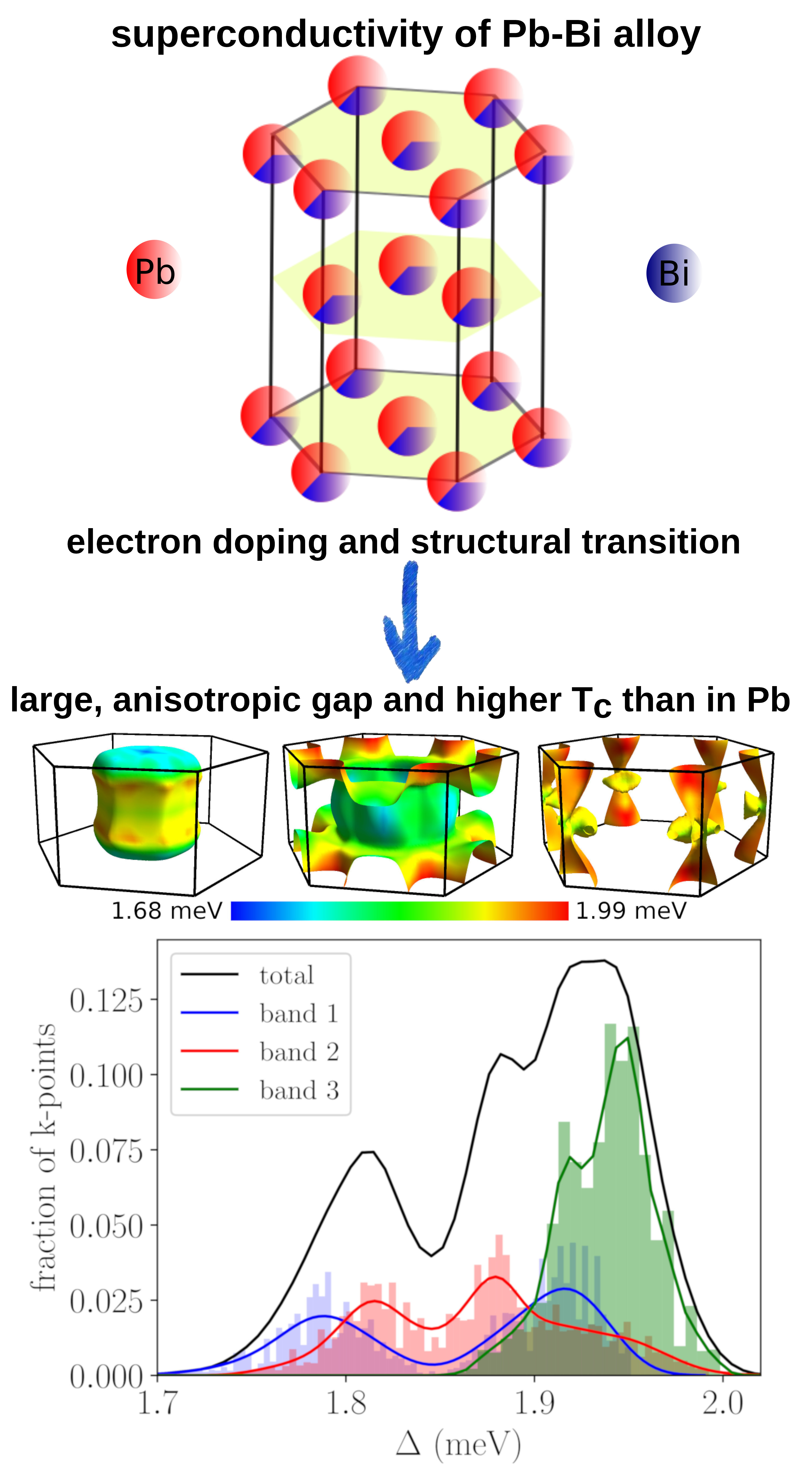
Figure: Formation of strongly coupled, anisotropic superconductivity in a Pb–Bi alloy (result from the Sonata Bis project).